
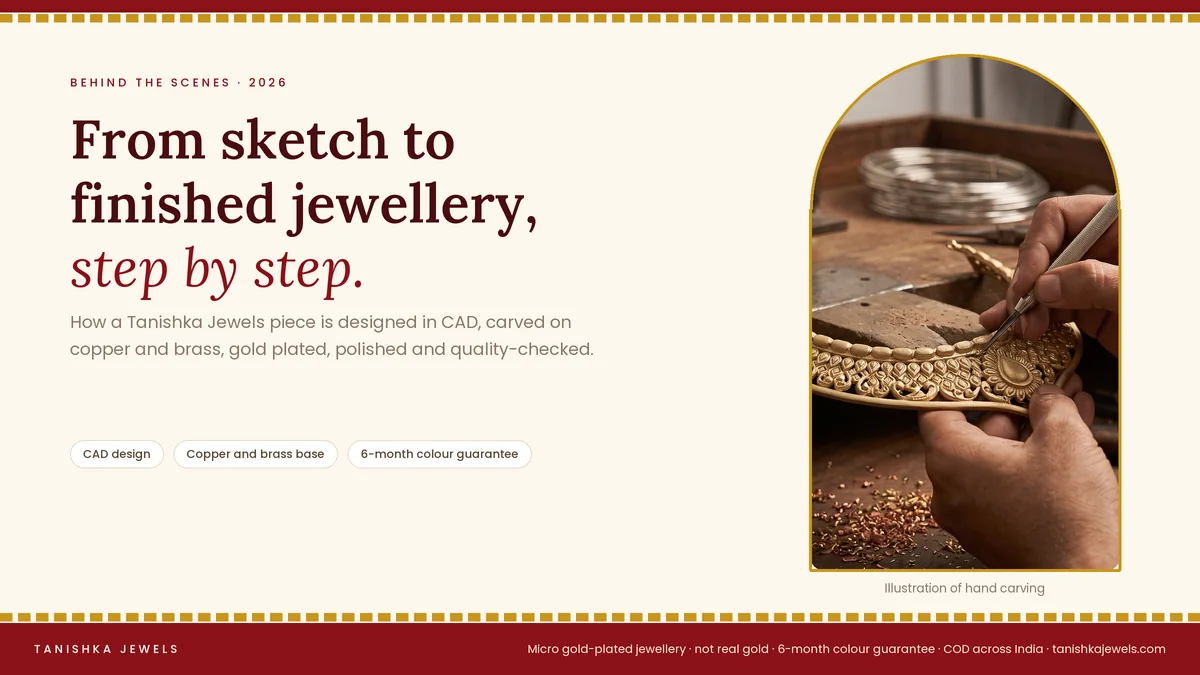
- Six stages: design and CAD, carving, refining and cleaning, plating, polish and checks, packing.
- The base is a nickel-free copper alloy and brass, carved with detailed patterns.
- Plating is multi-layer micro gold plating, 2–3 microns thick (imitation, not real gold).
- A clean, smooth surface is what lets plating bond, so cleaning matters as much as plating.
- Pieces are checked on finish, detailing, durability and colour; a 6-month colour guarantee and tiered buyback apply.
You pick up a necklace with fine beadwork and a deep gold tone, and two questions follow: how is this made, and why does it cost ₹1,199 and not lakhs? This guide walks through each stage. The pictures are illustrations of the stages, not photographs of our workshop.
How does Tanishka Jewels make gold plated jewellery?
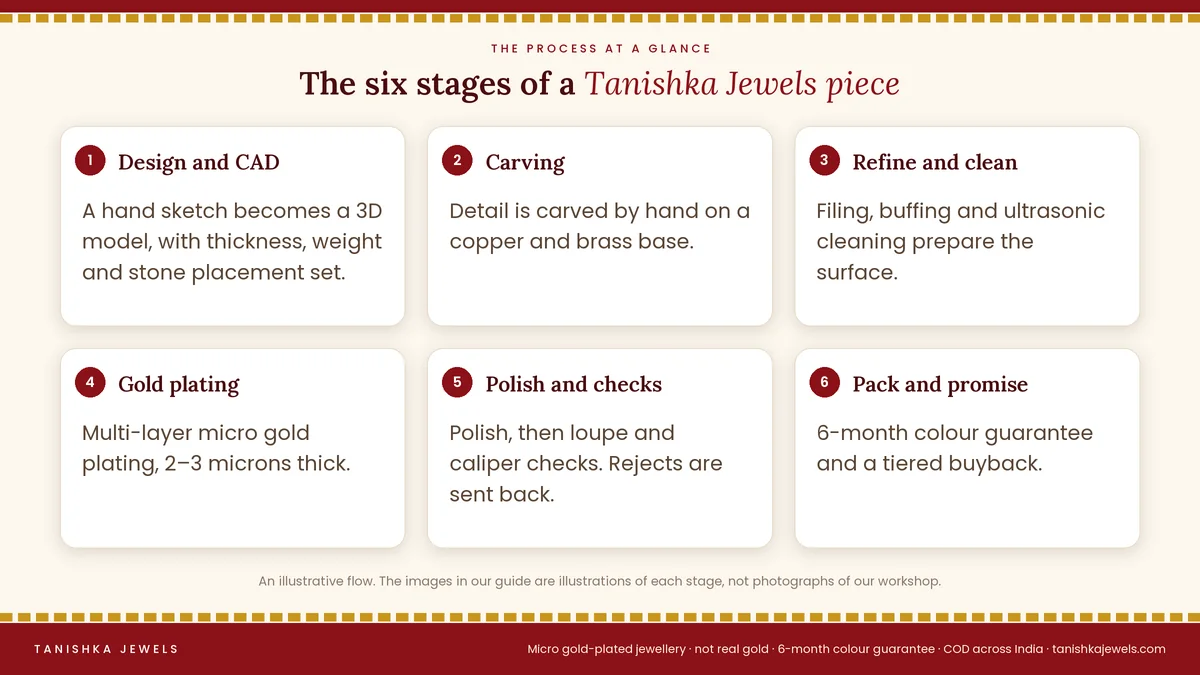
Every piece passes through six stages: design and CAD modelling, carving on copper and brass, refining and cleaning, multi-layer gold plating, polishing and quality checks, and packing. Tanishka Jewels sells micro gold-plated (imitation) jewellery, not real gold: multi-layer plating, 2–3 microns thick, over a nickel-free copper-alloy base. The steps are ordered so that each one prepares the next.
| Stage | What happens | Why it matters |
|---|---|---|
| 1. Design and CAD | Sketch, then 3D model | Proportion, weight and stone placement are set first |
| 2. Carving | Hand carving on copper and brass | Detail is built into the metal |
| 3. Refine and clean | Filing, buffing, ultrasonic cleaning | A clean surface lets plating bond |
| 4. Gold plating | Electroplating in multiple layers | Builds the 2–3 micron gold finish |
| 5. Polish and checks | Polish, loupe and caliper inspection | Finish, detail, durability and colour are checked |
| 6. Pack and promise | Packed with guarantee terms | A 6-month colour guarantee backs the finish |
How does a design become a CAD model?
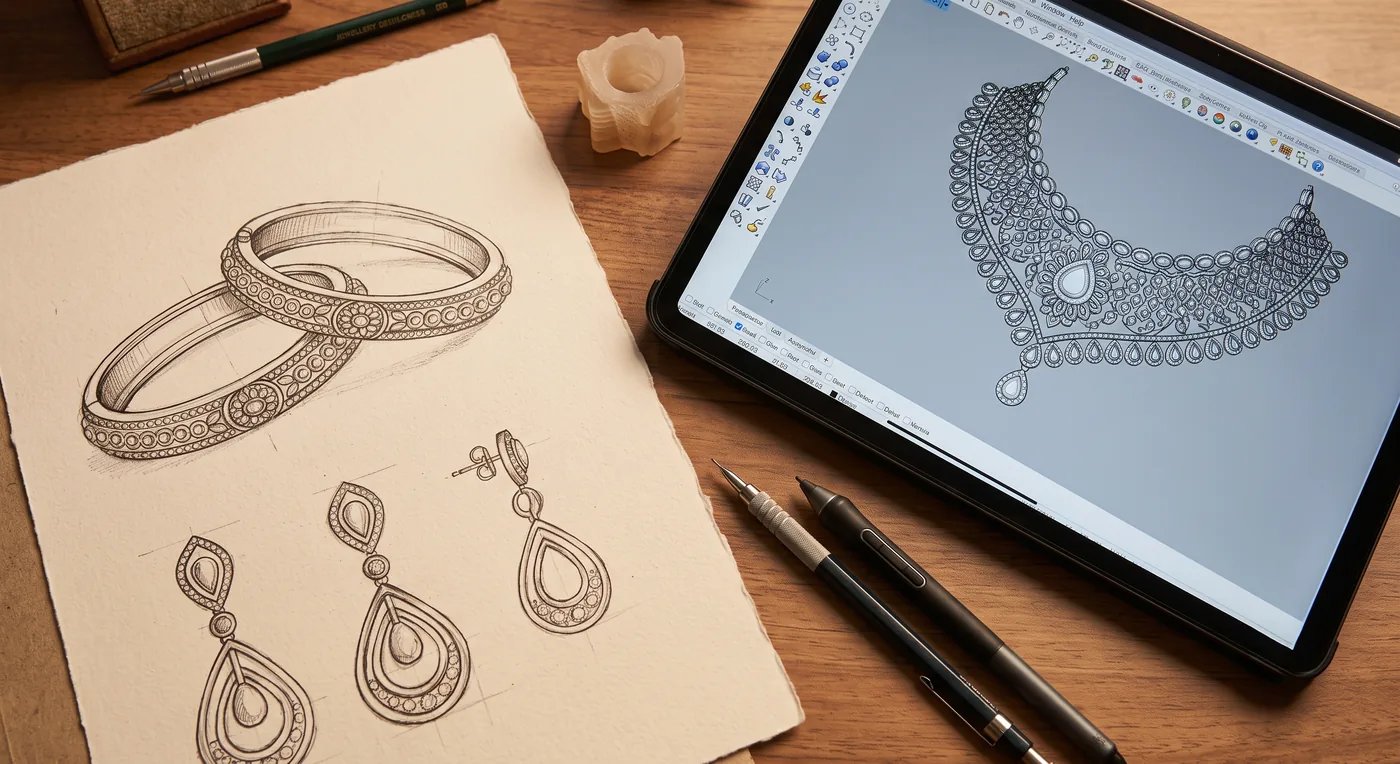
Each design starts as a hand sketch, inspired by Indian heritage motifs and current trends, and moves into CAD (computer-aided design), where it is modelled in 3D. The team can turn the model around on screen and set thickness, weight and stone placement before anything is made. Designing in CAD is how we aim for the proportions of fine gold jewellery, and a prototype is checked before a production run.
Why are copper and brass the base metals?
A base metal has to be stable, carve well and hold plating. We use a nickel-free copper alloy and brass, because a base that corrodes lifts plating from underneath. Nickel is also the most frequent contact allergen, which is why the base is nickel-free; skin reactions still vary by person. Our guide to how long gold plating lasts explains how base metal and thickness affect plating life.
How are the details carved and finished by hand?
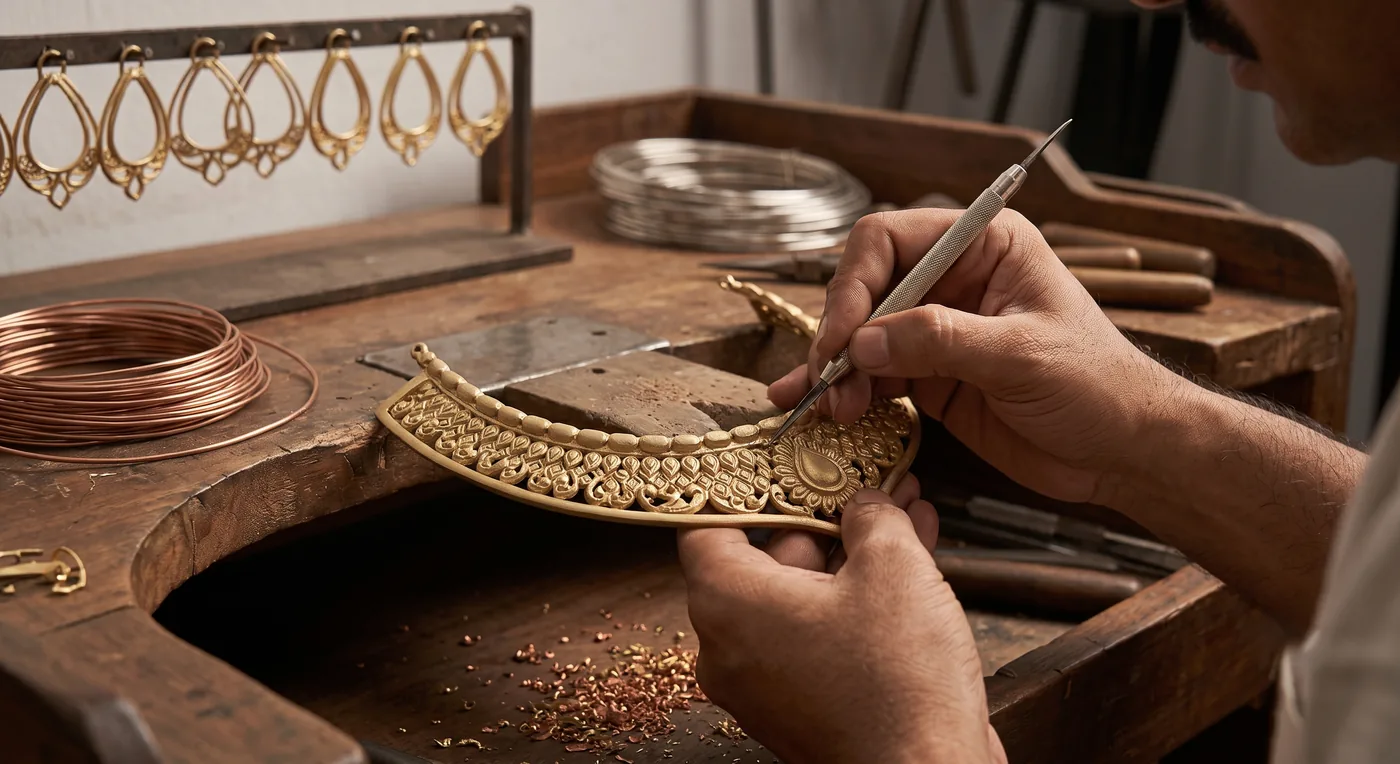
Experienced artisans carve patterns onto the raw metal with hand-held tools, whether it is the beadwork of a bridal choker or the embossing on a bangle. Stones are set and edges are filed by hand. Carving directly on the base metal keeps the pattern sharp, which is what gives a Rani Haar or a jhumka its gold-like detail.
Why do refining and cleaning come before plating?
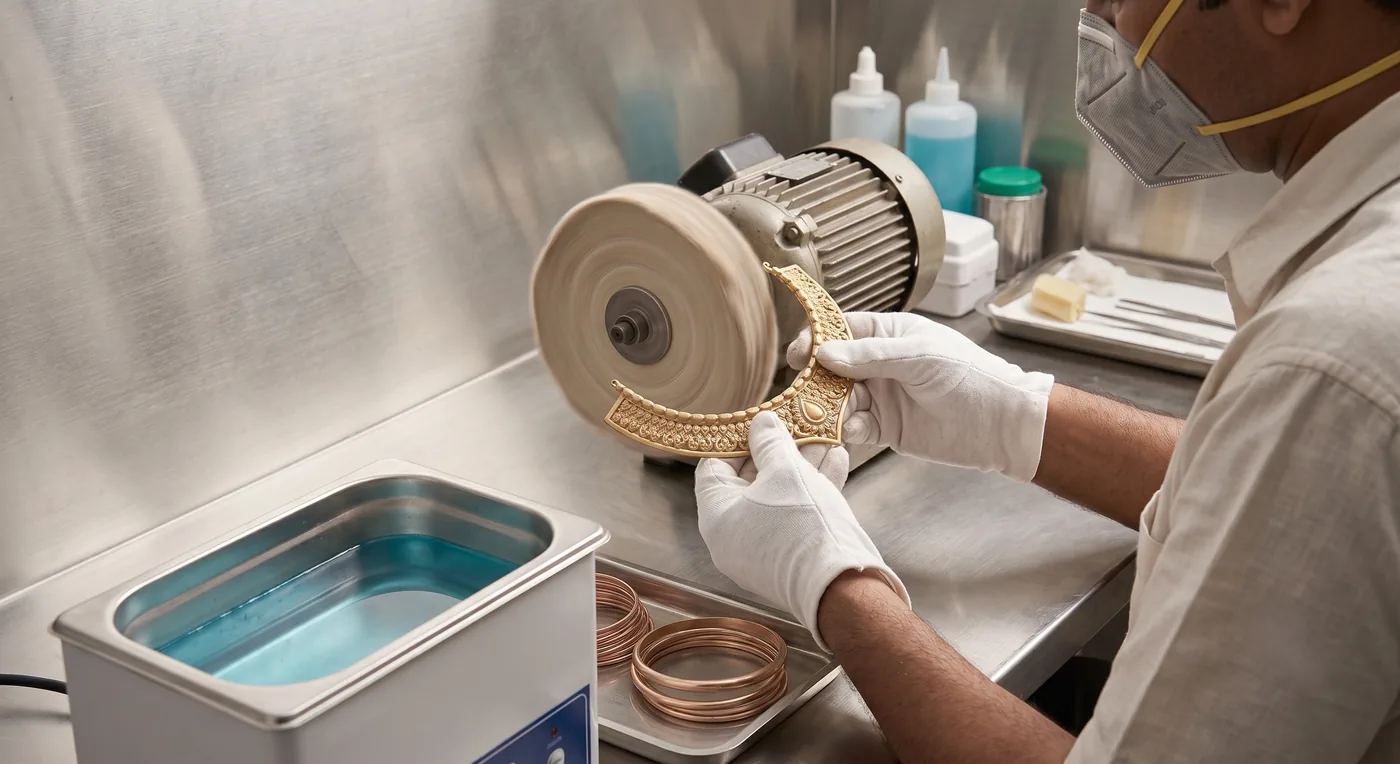
Plating only bonds to a clean, smooth surface, so this stage decides how the finish behaves later. Carving leaves burrs, rough edges and oxidation, so pieces are filed and buffed smooth and then cleaned in an ultrasonic bath. According to Ganoksin, most plating defects start with an unclean surface, because grease and oil stop plating from sticking.
How does gold plating work?
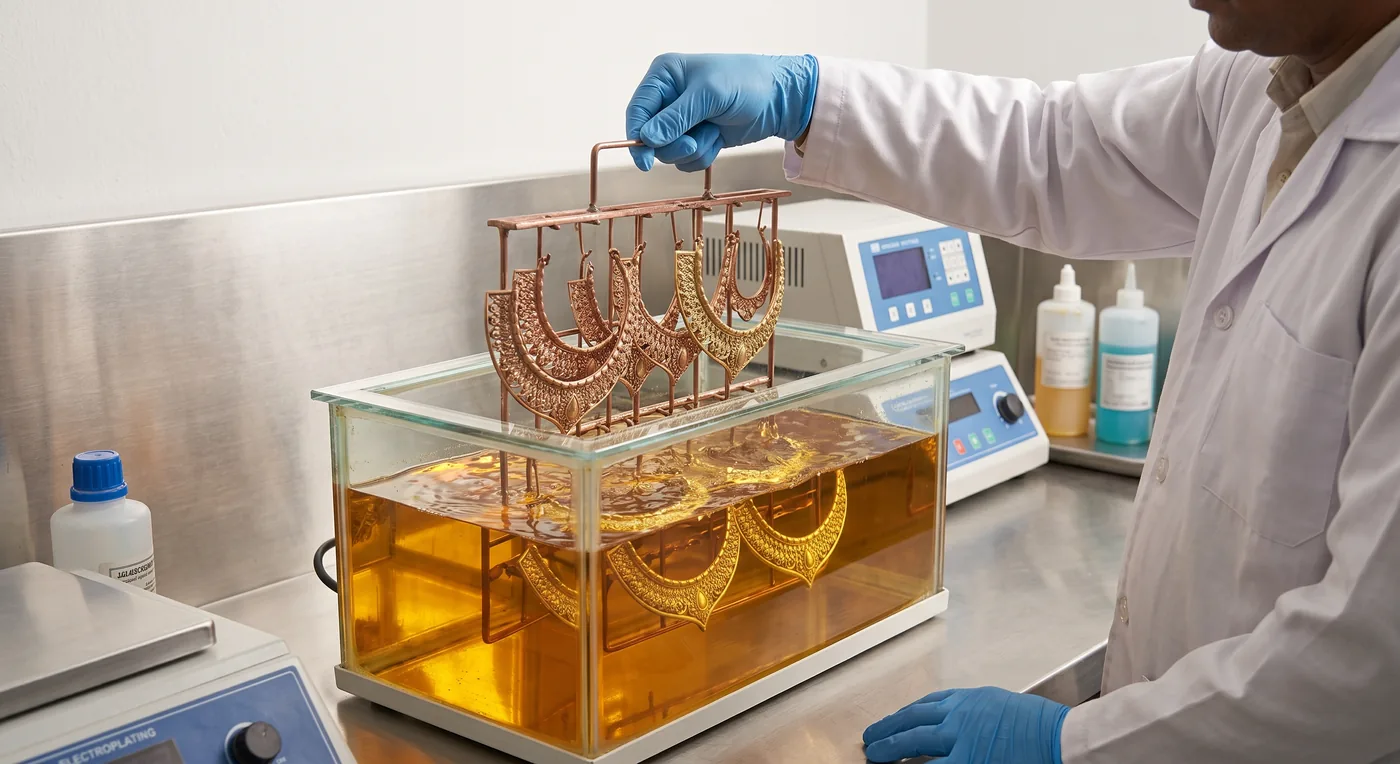
In electroplating, the cleaned piece hangs on a rack in a tank of gold solution, and an electric current deposits gold onto the metal surface. We build the finish in multiple layers to 2–3 microns. For context, the US FTC Jewelry Guides (Federal Register, 2018) call 0.175 microns “gold electroplate” and 2.5 microns “heavy gold electroplate”. Our figure is our published specification, not a claim of FTC grade, and the FTC is a US regulator.
Plating is a thin layer and it wears over time. How fast depends on thickness, base metal, skin chemistry and care, which is why we publish a care guide and a colour guarantee.
What happens during polishing and quality checks?
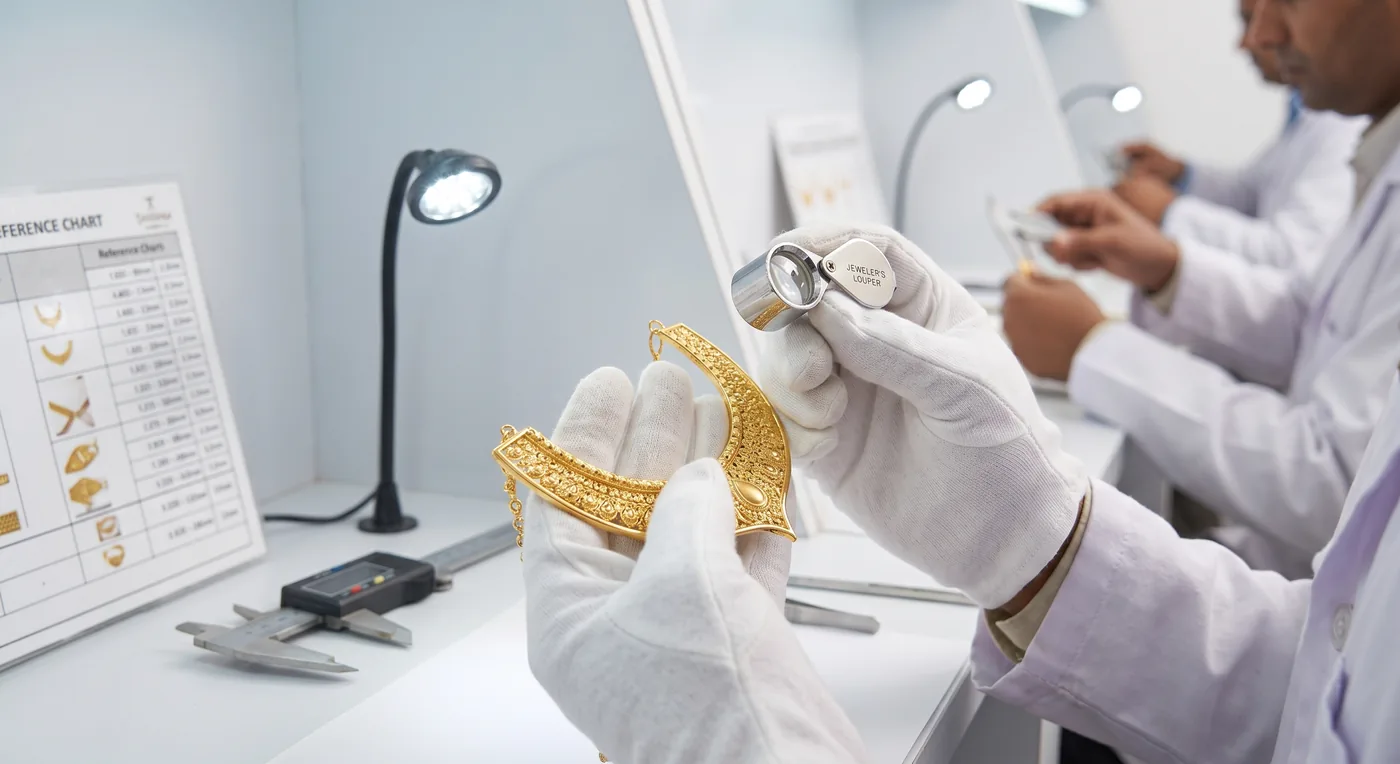
After plating, pieces are polished and then inspected under bright light with loupes and calipers. Inspectors check the consistency of the plating, the tightness of stone settings, clasps, the flexibility of links and every edge. We run multi-step checks of finish, detailing, durability and colour, and a piece with uneven plating or a rough edge is sent back instead of being packed.
What do you receive, and what backs it?
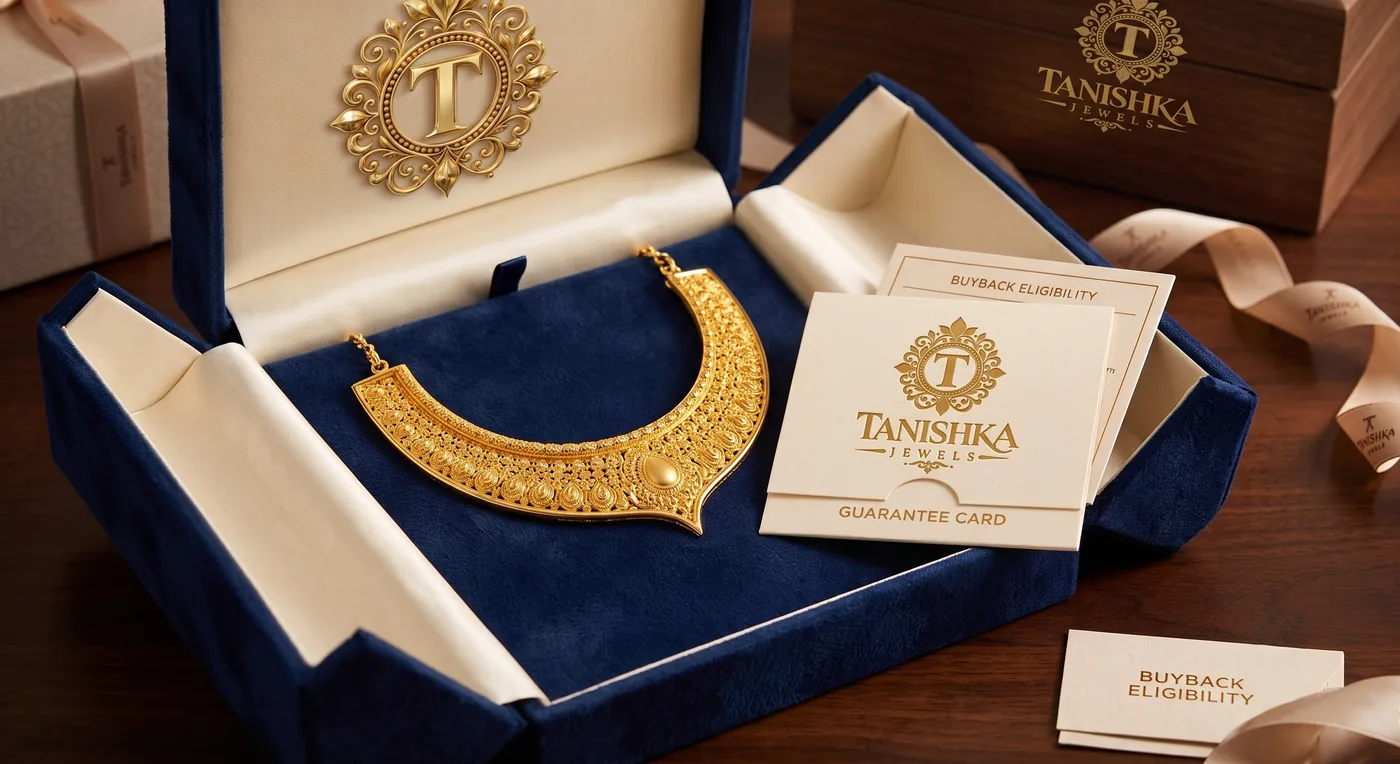
Each order ships with the same written terms, set out on our policy pages. The packaging contents can vary, but the promises below apply to every piece.
| Promise | Terms |
|---|---|
| 6-month colour guarantee | If the gold colour fades within 6 months, WhatsApp a photo to +91 81428 45928. A free replacement is dispatched within 48 hours, with no return shipping and no form. |
| Not covered | Physical damage (bending, breaking, cutting), loss or theft, and damage from chemicals, perfume or chlorine |
| Buyback | 50% of the purchase price within 6 months; 35% at 6–12 months; minimum ₹100 after that (cash/UPI or store credit). A partial refund that declines over time, not appreciation |
| Returns | 7-day returns from delivery for unused pieces in original packaging; exchange for a new design in months 7–12 |
Why can Tanishka Jewels keep prices accessible?
Two reasons. A gold plated piece contains no solid gold, and our process is built for volume: design, tooling and plating set-up are spread across many pieces, and we manage the steps from CAD to final polish as one process. For scale, 22K gold was ₹13,880 per gram on 10 October 2026 (Candere), so a 20 g necklace carries ₹2,77,600 in metal alone, before making charges and GST. Our Bridal Necklace, Wide 2.5 Layer costs ₹1,199.
What does this process promise, and what does it not?
It promises a carefully made, checked piece with a guarantee behind its colour. It does not promise real gold or lifetime colour: Tanishka Jewels sells imitation jewellery, and buyback is a declining partial refund, not an investment. Read gold plated vs real gold and what demi-fine jewellery is for the honest comparison.
Frequently asked questions
Transparency is part of the product. See the finished result in our necklaces, bangles and Rani Haar, or ask us about any design on WhatsApp.
Want to see the finished pieces?
Browse the collection, or message us on WhatsApp for the plating, base metal and care of any design. Cash on Delivery across India.
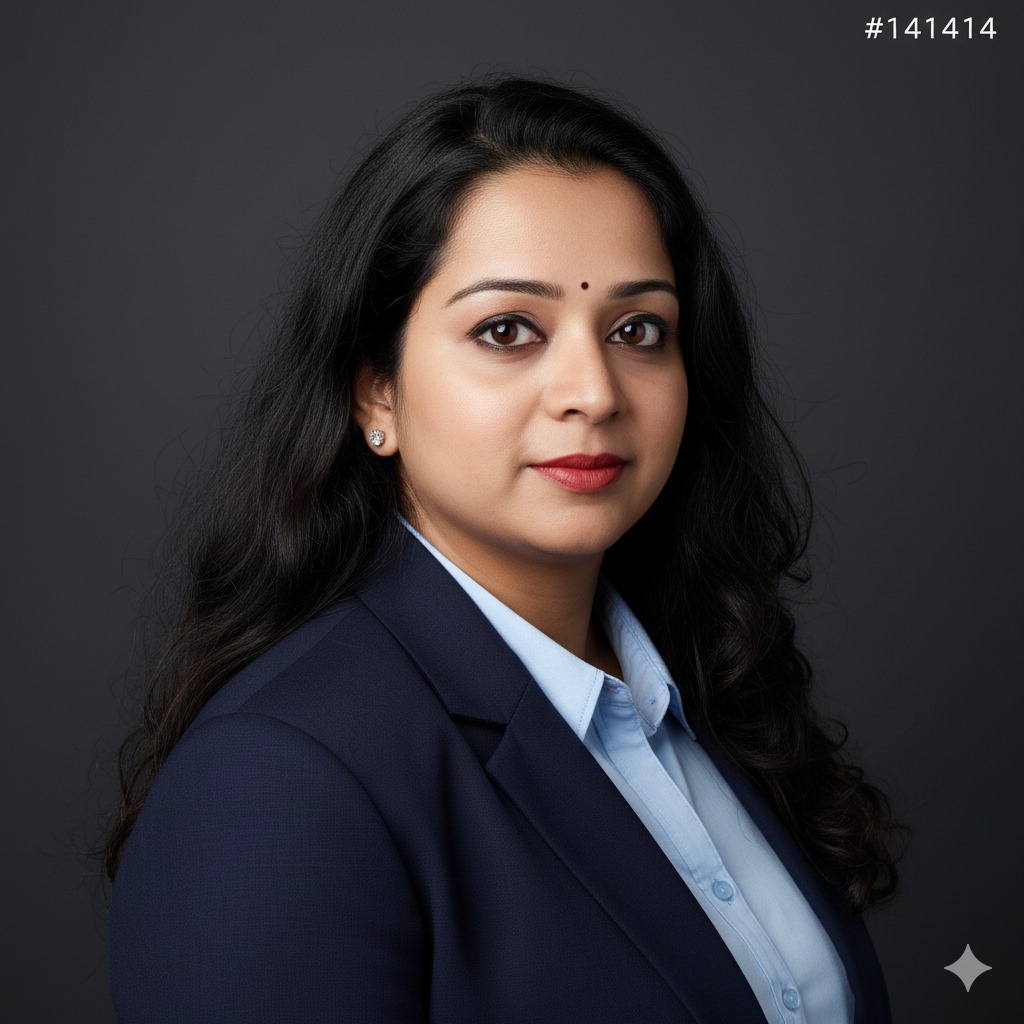
Deepa founded Tanishka Jewels to bring the look of fine gold to the modern woman: jewellery designed with a fashion-first eye, finished by hand and made to be worn, loved and remembered. Connect on LinkedIn →